
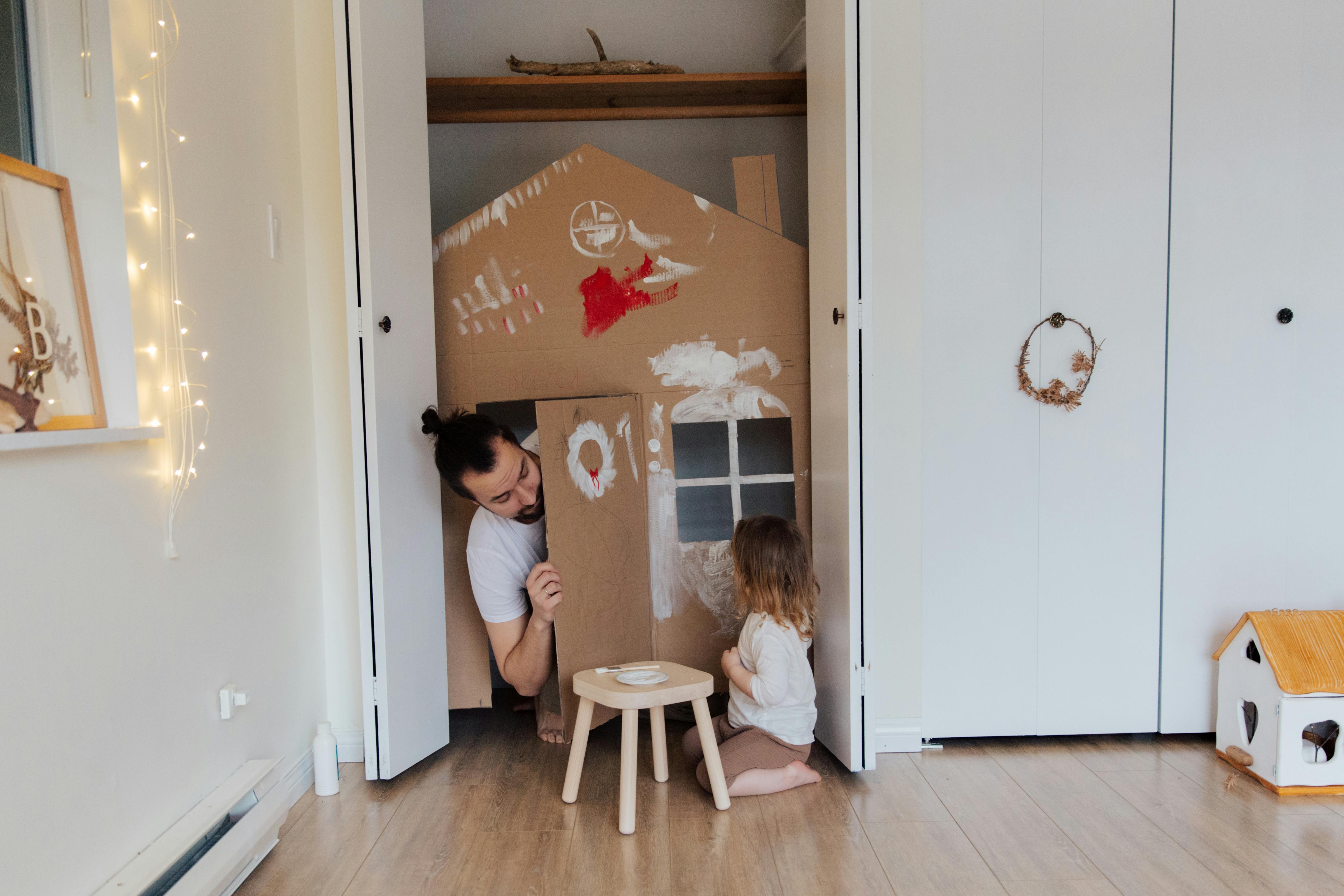
Linguistic mapping of play is a strategy for exposing children to adult speech and language in a relaxed, joyful setting. Plainly put— an adult describes what the child is attending to using simplified language. A parent can “put into words” what the child wants or is looking at, or add in commentary to narrate the play. This strategy allows the child to hear language that is necessarily relevant to them, and that comes to them without any accompanying demands. (For a kid who can barely talk yet, even formulating a response can be hard work.) If you find yourself asking a lot of unanswered questions while trying to engage with your child, this one is for you!
How to
When using this strategy, match the length of your sentences to the child’s sentences, and expand upon that by one word. If a client has no spontaneous language at all, an adult would use one-word utterances or use sound effects that are relevant to the play. You can offer narration as a bystander of pair these comments with other strategies for play sessions with more holistic learning. Children still acquiring joint attention skills will benefit from side-by-side play with organizational toys, for example. Children who are not yet using social gestures will benefit from narration and response to natural gestures like reaching for a toy. (For more on using a reach to build communication, read my free ebook, Baby Bright: Bookworms, 6-9 months.)
Some clients do not appear “soak up” these opportunities for learning— a very disappointing scenario for parents trying to make a connection with their children. If you relate, don’t despair! The foundational skills for this kind of learning can be taught, schedule a consultation to learn more.
The Science
Linguistic mapping offers parents a strategy to support their child’s language development by creating a language-rich environment for their child to learn from. To learn more about who this intervention serves best, read this 2013 review of outcomes for toddlers with ASD, published by the Journal of Autism and Developmental Disorders, another peer-reviewed journal.
If needed, this practice lends itself to more comprehensive naturalistic interventions. In my practice I draw from a wide variety of resources for these, including Prelinguistic Milieu Teaching, Pivotal Response Teaching, the Early Start Denver Model, and J.A.S.P.E.R. These approaches are supported by the evidence in their own right and belong to a family of approaches that are also supported by the available evidence. The National Autism Center’s National Standards Project, a systematic review of treatments for autism, presents this information well and I encourage my readers to review their report.
For more about linguistic mapping, this 2012 article from Autism, a peer-reviewed academic journal, describes linguistic mapping and expansions, as well as related measures like “follow in” commentary, prompting, and redirects.
Get coaching
Email Spectrum Behavioral Services of Kentuckiana to discuss services for your child or make a referral.


 Spectrum Behavioral Services of Kentuckiana
2 thoughts on “Linguistic Mapping: Enhancing Child Language Skills”